





7 Things You Are Doing Wrong With Your Watch
Watch Care Tips From Sheiban Jewelers
Fine watches are companions throughout life, often being passed from generation to generation. They are items to be enjoyed, worn, and appreciated. But, as with any luxury item, they do require a certain level of care. Here are seven habits to avoid and watch care tips that will help keep your favorite timepiece a cherished companion for all the years to come.

1. Setting The Date In The Danger Zone
No, this does not mean while listening to Kenny Loggins. The “danger zone” is the period between 9:00 PM and 3:00 AM. This may sound arbitrary, but it is actually hyper-specific to how a watch’s date complication functions. The mechanism responsible for the date change begins to engage during this period — forcing them into action while they’re already under tension can result in damage ranging from minor to severe. If the date must be changed, go ahead and move the time past 3:00 to ensure that the date mechanism has fully disengaged, set the desired date, and then reset the time.

2. Using Chronograph Pushers Or The Crown Underwater
Water, even for highly water-resistant watches, can be a killer. Crowns and chronograph pushers represent potential ingress points for water; manipulation of these points can cause your watch to flood. In fresh water, this is a big concern. In salt, it’s potentially disastrous. Avoid actuating chronograph pushers and manipulating the crown underwater as a best practice. Sometimes seals fail even above the surface; however, a humid climate can exacerbate this issue. If you notice signs like internal fogging of the crystal, it is time to bring your watch in for service.

3. Adjusting The Crown With The Watch On Your Wrist
Anyone with multiple watches has likely been there — you grabbed a watch on your way out the door, only to release it hadn’t been wound or that it hadn’t been set recently. Instinct may say to simply adjust the crown as the watch is worn, but this is a bad idea. Instead, remove the watch from your wrist and make your adjustments there. The reason is simple — it’s about pressure. Adjusting the crown while on the wrist applies unreasonable force to the crown stem connecting the crown to the movement; if this stem breaks, you cannot wind or set the watch. Making adjustments with the watch held in the hands means that this directional pressure is not applied.

4. Leaving The Crown Unscrewed
Screw-down crowns are a desirable feature on a watch, but for anyone unfamiliar with their operation, they can be confusing. The series of gaskets located variably in the case, in the crown stem, and in the crown serve to help prevent water intrusion. However, they cannot do their job if the crown is in the open position. A screw-down crown ensures that this opening is prevented, helping the watch maintain its water resistance. It also helps ensure that the crown is in a safe position, protecting the delicate crown stem connecting it to the movement.

5. Ignoring Service Intervals
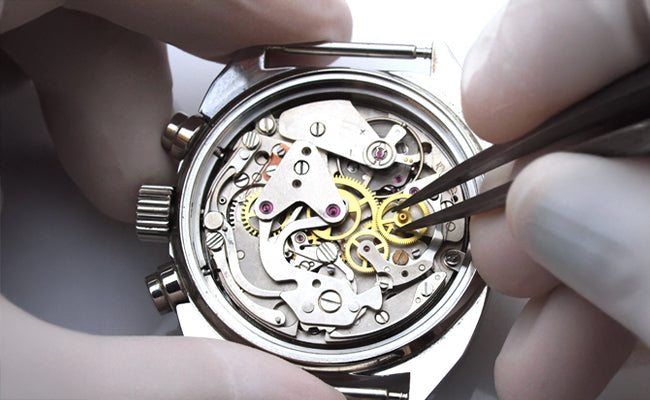
Much like a car, a mechanical timepiece requires upkeep to keep it running in tip-top shape. Preventative maintenance through following a conservative service interval schedule can go a long way in preserving your watch for the long haul. Sometimes, however, problems arise in between. Here are a few warning signs to keep an eye out for:
The watch is suffering a severe drop or gain in timekeeping.
The crown is stiff or a bit unresponsive during winding.
Unusual noises during hand winding or from the automatic rotor.
The watch’s power reserve does not last as long as it should.
Not sure about your watch’s recommended service interval or just have questions? Reach out at (440)-238-0616 or https://sheibanjewelers.com
Our in-house watchmaker is able to undertake anything from simple battery changes all the way up to mechanical services and restorations. Give us a call at the number above or visit our website to schedule your service today.

6. Don’t Overwind Your Watch
If your watch is quartz or an automatic, don’t worry, this doesn’t apply to you. But if your watch has a manually-wound movement, overwinding can lead to disastrous consequences. A mechanical watch is built around a coiled metal spring referred to as the mainspring. Every function of a timepiece relies on the energy provided by the mainspring as it slowly releases that tension. Herein lies the problem: if the mainspring is subjected to too much tension, it may break, effectively rendering the watch dead. Not to worry, this is a replaceable part, but it is an easily avoidable issue. Manually-wound movements provide feedback as you wind them. When you begin to feel resistance, stop. If worn daily, such as the Omega Speedmaster Professional, then the initial winding will be longer than the following ones due to some power reserve remaining.

7. Beware Of Magnets
For decades, magnets wreaked havoc on mechanical watches. The delicate metal components inside fine timepieces can be inadvertently affected by exposure, resulting in sharp drops in accuracy or even complete stoppage of the movement. The good news? It’s easily reversible and often poses no long-term ill effects. Many modern timepieces are protected against high labels of magnetism, but can still be impacted by exposure to daily items using them. If your watch shows signs of being magnetized, bring it by our showroom at 16938 Pearl Rd, Strongsville, OH 44136, or reach out for help.

Watches have come a long, long way in the last century. For the most part, they can be worn through far worse circumstances than the average person will subject them to in day-to-day life. More or less any mechanical watch produced today is capable of lasting for generations. For the best results, by avoiding those seven actions above, you can help preserve your timepiece for the long haul.
Want to learn more? Sheiban Jewelers is here for you during every step of your watch enthusiasm, from beginner to expert collector. Stop by our Cleveland showroom visit us online at https://sheibanjewelers.com.
FAQ
What is overwinding a watch?
Overwinding a watch is when a watch is wound past the point of resistance and the mainspring is either damaged or broken. This prevents the watch from running and requires a full service to ensure no other damage occurred.
How do I know if my watch is magnetized?
One of the simplest methods to confirm a watch is magnetized is to grab a compass and observe if there is any effect on the needle. If so, the watch will need to be demagnetized.
How do I screw down a crown?
There are multiple techniques, but to avoid cross-threading the crown threads, a popular method is to push down on the crown, rotate counterclockwise until it seats, and then proceed to screw down the crown clockwise.
What is a watch’s power reserve?
Power reserve refers to the number of hours a watch will run. They can range anywhere from a couple of days to over a week in length.
What is the recommended service interval for my watch?
Each manufacturer recommends their own service intervals based on the movements they use. This also varies by watch; for example, a dive watch seeing regular exposure to water may benefit from more frequent servicing of gaskets and pressure testing. If you aren’t sure, reach out, and we’ll be happy to advise.
How do I tell how much water resistance my watch has?
A watch’s water resistance rating is typically located on the caseback, specified in terms of atmospheres of pressure (ATM) or meters (M).
What is a complication in a watch?
A complication is any feature, like a chronograph, date, power reserve, et cetera, that a watch features beyond its standard time-telling function.